
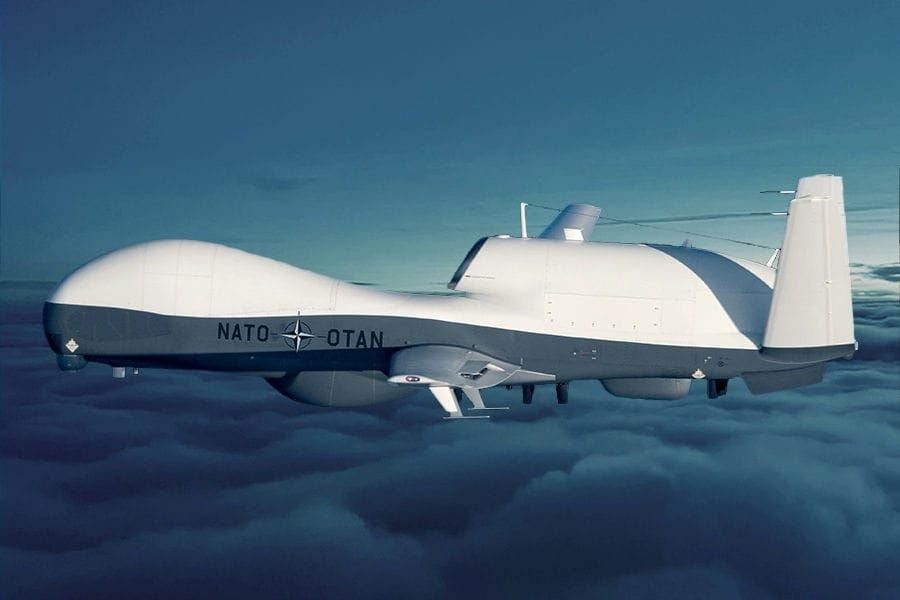
Northrup Grumman looks to close NATO Triton contract, reports record backlog
Northrop Grumman executives said they expect to work “throughout the remainder of this year” to close a contract with NATO for up to five unmanned Triton unmanned maritime intelligence, surveillance, reconnaissance (ISR) and targeting aircraft.
Denmark, Finland, Germany and Norway said on July 6 that they would buy “up to five” MQ-4C Tritons for NATO’s Intelligence, Surveillance and Reconnaissance (ISR) Force.
(Northrop Grumman will build the unmanned aircraft, but “Airbus Defence and Space and other European companies will provide the ground segment, data management services, command and control, infrastructure and mission support,” they added.
Northrop Grumman reported a record high backlog of $105 billion on a Q2 2026 earnings call late Tuesday (July 21). CEO Kathy Warden told analysts that she sees NATO’s move to negotiate acquisition as “endorsement for products like Triton that are mature production programs that we can deliver off of our production line with relative speed and being able to support a very important mission of surveillance in the high north…”
But she somewhat played down unmanned systems as a major growth opportunity for the defense prime, saying “we do see our unmanned systems continuing to contribute to our overall company international growth, but we have numerous growth drivers internationally.”
Warden pointed to “munitions, IBCS…other platforms like E-2D, manned platforms…”
Northrop Grumman is a developer, producer and integrator of medium caliber gun and ammunition systems that “defeat class 1 and 2 drones, as well as small land and surface water vehicles.” Its new AiON Counter Unmanned Aircraft System (C-UAS) proposition is yet to make a dent in earnings however and was only released in May 2025.
AiON is its response to the US Defense Innovation Unit’s (DIU) Forward Counter Unmanned Aircraft Systems (C-UAS) C2 solicitation issued in December 2024.
The company says it can operate both in cloud environments and on tactical edge hardware as a “low-cost and low-risk command-and-control solution” – and describes it as “suitable for law enforcement, military, and civil use.”
It tested the solution in December 2025 at Yuma Proving Ground, Arizona, where it “successfully demonstrated the capability to detect, track, identify and neutralise both simulated and real targets during four engagements.”
It did not name the type of target nor neutralisation approach.