
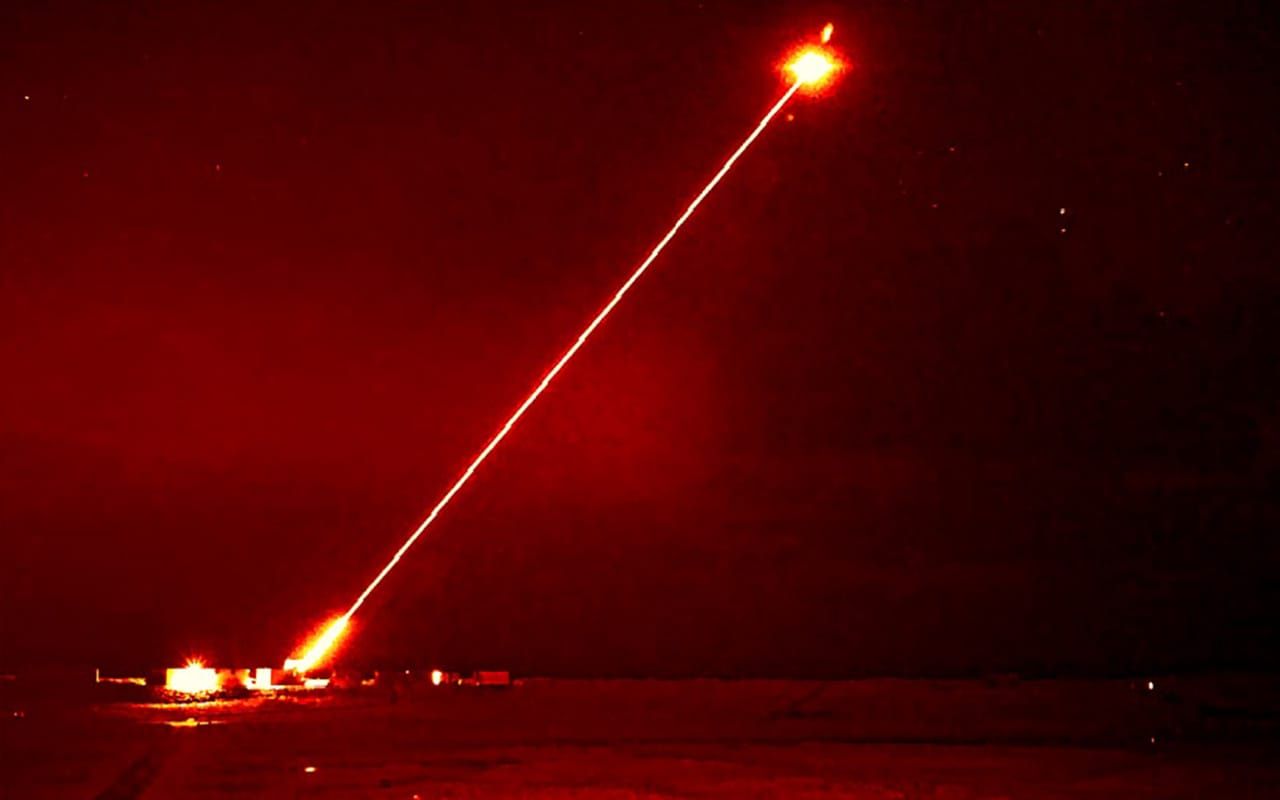
The UK’s QinetiQ is rebranding its coherent beam combination (CBC) High Energy Laser (HEL) family of products as Helena - and putting £20 million more behind development and production.
In a detail-thin press release ahead of the Farnborough Air Show, Qinetiq’s group CEO Steve Wadey said: “Directed Energy Weapons are quickly moving from development to deployment to change the game in battlefield economics against the drone threat” – adding that the investment “demonstrates our commitment to accelerating both the development and manufacture of sovereign laser technology.”
The investment comes after the UK vowed in its late June Defence Industrial Plan to invest £790 million in integrated air and missile defence, including improved C2 capabilities, to “buy new radars and sensors as well as additional short range counter-drone systems” and “continue to invest in Directed Energy Weapons…”
Officials pledged in the plan to invest £490 million to develop Directed Energy Weapons, “including to deliver the DragonFire system on Royal Navy Type 45 destroyers from 2027.” (DragonFire is a consortium led by MBDA with QinetiQ and Leonardo.)
It remains unclear how committed officials are to ensuring that target date is met.
£10 per shot?
The UK Ministry of Defence suggested precise cost benefits in 2024 when announcing successful test-fire of DragonFire, saying it had an approximate cost per shot of £10 ($12–13) and claiming that “Firing it for 10 seconds is the cost equivalent of using a regular heater for just an hour.”
Laser Directed Energy Weapon (LDEW) technology could “revolutionise the future battlefield by allowing armed forces to operate without ammunition, reducing the risk of collateral damage,” advocates and project partners like Leonardo claim. (Leonardo is providing the system's beam director, which is integrated into a turret to aid the advanced targeting of the incoming threat at various ranges.)
The DragonFire laser directed energy weapon (LDEW) system first achieved the UK’s first high-power firing of a laser weapon against aerial targets in 2024 during a trial at the MOD Hebrides Range, the consortium said.
LDEW systems are expected to be particularly effective against aerial threats with thin-walled structures, exposed sensors, and temperature-sensitive electronic subsystem, like commodity UAVs.
DEW's are set to be disruptive
Early experiments in the US (e.g. the Navy’s efforts with a 30-kilowatt laser, LaWS, on the USS Ponce) threw up challenges around stand-alone systems that “don’t connect to the combat system that controls a ship’s permanently installed weapons and sensors,” as Breaking Defense noted in 2019.)
As RAND noted of LDEW, successful deployment of such weapons types could be significantly disruptive to the defense industry – and not just on the battlefield. The think tank’s Stuart Dee and James Black commented in 2024 that “companies in the business of making complex weapons (military-speak for missiles) don't just chase the one-off paydays that come from selling new weapons. Margins on these initial contracts are often fairly low, especially compared to other more profitable sectors such as tech.
“As such, companies—and the private finance that backs them—tend to bet their long-term prospects on their ability to secure not only a steady flow of follow-up procurements by domestic or export customers, but also recurring payments for through-life services such as maintenance, repair, and upgrade work.”
“But laser and microwave weapons may also upend the industrial and commercial logic that has shaped the complex weapons sector since World War II… while DEW platforms can rebalance asymmetry in conflict by cheaply and quickly neutralising low-cost threats, this could inflict collateral damage on the long-term revenue surety of the defence companies needed for their development.”